Sunday, October 12, 2025

The History of Trinidad under the Spanish Government by P.G.L. Borde


"Nothing would be so unbearable to us as to see this historical essay pass by un-noticed by our compatriots, since it is for them that we have undertaken it."

Pierre Gustave Louis Borde was born in Trinidad in the year 1820 and dedicated his last years to writing a history of Trinidad from the discovery by Columbus in 1498 to the British conquest in 1797. 

With these two books, published here for the first time in one cover, he made a major contribution to the evolution of historical writing about the West Indies. Elsa Goveia, in her seminal study of the historiography of the West Indies, praises Borde as a competent historian who ranks high among 19th century writers on Caribbean history. 

A well educated and literary man, Borde devoted many years of his life to research for the writing of these invaluable books on Trinidad, the island he loved so well and of which he was a loyal and staunch citizen.

"For the scholarly qualities of his History of Trinidad under the Spanish Government, P.G.L. Borde deserves to be far better known to, and appreciated by, his fellow Trinidadians of the late 20th century." (Bridget Brereton)

Paria Publishing Co. Ltd. published Borde in 1982 as the first historical publication after the company's founding in 1981. We are happy to re-issue the book in a revised version with the French and Spanish appendices translated into English.

Softcover, 6 x 9", 892 pages

ISBN 978-976-8244-50-5

Available on Amazon and Barnes and Noble


Tuesday, November 5, 2024

The Large Paria Colouring Book

Going through a box of old artwork, we discovered some beautiful original drawings that were done some time in the late 20th century, of things children did for fun.  

Paria Publishing decided to create a colouring book of individual pages with these drawings for the children of today to use and to create some nostalgia for the children of the past.  

There are twelve drawings in the folder, ready for the budding artist.  The Large Paria Colouring Book is only available from bookstores in Trinidad and Tobago.

Below you can see all the drawings from the folder. 


Tuesday, September 17, 2024

Standing Tall

The Inspiring Story of Kayla-Jordan Parris

1999–2023

Collated & Edited by Christine Parris-Debique


“I cleared my mind from the negatives

And had to open up and see

That I have lupus

Lupus doesn’t have me!” 

In her own words from her poem Lupus II, Kayla, forever the spirited child of words and passion, was a life force to be reckoned with during her years on earth. A fiercely intelligent and vivacious spoken word poet and performer, gifted with words and wit, she commented on what was going on around her from a very young age. 

This memoir of Kayla’s life, put together by her grandmother, minces no words about how Lupus destroys, bit by bit, organ by organ, the beautiful strong body of a child, teenager, young woman—and that of her mother with a similar condition. But the many contributors to this book, and Kayla’s own words, balance this with what she was really about: a powerhouse of talent and determination, a Caribbean child full of love and kindness, a daughter, a sister and a great friend who was truly larger than life for everybody who had the good fortune to meet her.

Let Kayla-Jordan Parris show you what it means to live life to the fullest in the face of unsurmountable adversity.


About the Author/Editor:

Christine Parris-Debique was born in the Republic of Trinidad and Tobago and has lived there for most of her life except for sixteen years spent in the neighbouring island of Barbados.  She holds a BSc in Management Studies from The University of the West Indies and is a Fellow of the Association of Certified Chartered Accountants, U.K. She is the mother of three sons and grandmother of two granddaughters and two grandsons. She lives in Petit Valley, Trinidad with her husband and Standing Tall is her first published book.


ISBN 978-976-8341-43-3

Paperback

188 pages

Fully illustrated in colour


Available in select bookstores in Trinidad.

"YOU ARE FIRED!" A Handbook on Dismissal

by Deborah Thomas-Felix (Author) 

This legal textbook covers several areas of Labour Law, Employment Law and Industrial Relations. It discusses topics such as Dismissal (firing ,the termination of employment) the importance of work, workplace related issues,the right to be heard , among other things.

Work is the primary engine for the creation, distribution and utilisation of the economic resources within a state or a nation. Its multifaceted contributions to economic growth, income generation, resource allocation and social well-being, underscore its central importance in shaping the economic and social fabric of society. The effect of a dismissal can also be the cause of strained relationships between employees and employers, particularly if the dismissal is perceived to be unjust or unfair. 

In addition, poorly managed dismissals can damage trust, morale and the organisational culture, which can lead to negative consequences for productivity and employee engagement. Moreover, dismissals raise issues related to employment rights, including the legality and fairness of the dismissal process. In many jurisdictions, workers have legal protection against dismissals which may be termed “unfair dismissals”, “wrongful dismissals” or “harsh and oppressive”. 

These protections include legal requirements for due process, fairness, just cause, compensation, reinstatement and/ or re-appointment. Dismissals do not only impact individuals, but can impact Labour market dynamics by influencing factors such as the unemployment rate, labour supply and demand and job turnover. In fact, mass retrenchment or layoffs due to corporate downsizing for example, can have ripple effects on industries and economies.


548 pages

Paperback, Hardcover, Kindle


Available on Amazon

Philippine - Book Second and Third (Souls on Fire, The Representative Man)

Book Second of the Philippine trilogy follows the lives of Dr. Jean-Baptiste Philip, the "Free Mulatto", a descendant of Jeannette and Honoré Philip of one of Book First. 

As one of the Souls on Fire of the early 19th century Romantic Movement, and as an alienist, Dr. Philip fought and won the first civil rights case in the New World on behalf of the free coloured people in Trinidad-an achievement that with emancipation benefitted the former slaves, and in the long run the entire population-while exploring the effects of colonial prejudice on the psyche of his people.

Book Third is a biopic of Maxwell Philip, another descendant of the Philip family in Trinidad. He became "The Representative Man", a political and legal luminary of Port of Spain of the mid-19th century. In a delightful plot the author lets C.L.R. James "discover" Maxwell in his interviews with Captain Arthur Andrew Cipriani in the 1920s. 


About the Author:

Born in 1942, Gérard A. Besson is an independent researcher and scholar in the area of History of Trinidad and Tobago. His oeuvre comprises many titles, both non-fiction and historical novels as well as works about folklore. Besson is the recipient of the Hummingbird Medal Gold of the Republic of Trinidad and Tobago and of an honorary doctorate of the University of the West Indies. He is the founder and chairman of Paria Publishing Company Limited.


Other works by Gérard A. Besson:

Fiction:

Tales of the Paria Main Road (Creative Advertising 1973); A Diary of Dreams (Paria Publishing 1988); The Voice in the Govi (Paria Publishing 2011); From the Gates of Aksum (Paria Publishing 2013); Roume de St. Laurent ... A Memoir (Paria Publishing 2016); Philippine Vols 1 and 2 (Paria Publishing 2024). 


Non-Fiction: 

A Photograph Album of Trinidad at the Turn of the 19th Century (Paria Publishing 1985 and 2024); From Colonial to Republic (Republic Bank, with Selwyn Ryan 1987); Folklore and Legends of Trinidad and Tobago (Paria Publishing 1991); The Book of Trinidad (Paria Publishing, with Bridget Brereton 1991 and 2010); The Angostura Story (Paria Publishing 2000); The Angostura Historical Digest (Paria Publishing 2002); Scotiabank - The First 50 Years (Paria Publishing 2004); The History of Ansa McAL in the Caribbean (Paria Publishing 2006); The Cult of the Will (Paria Publishing 2010)


ISBN: 978-976-8244-55-0

460 pages

Paperback

Available on Amazon


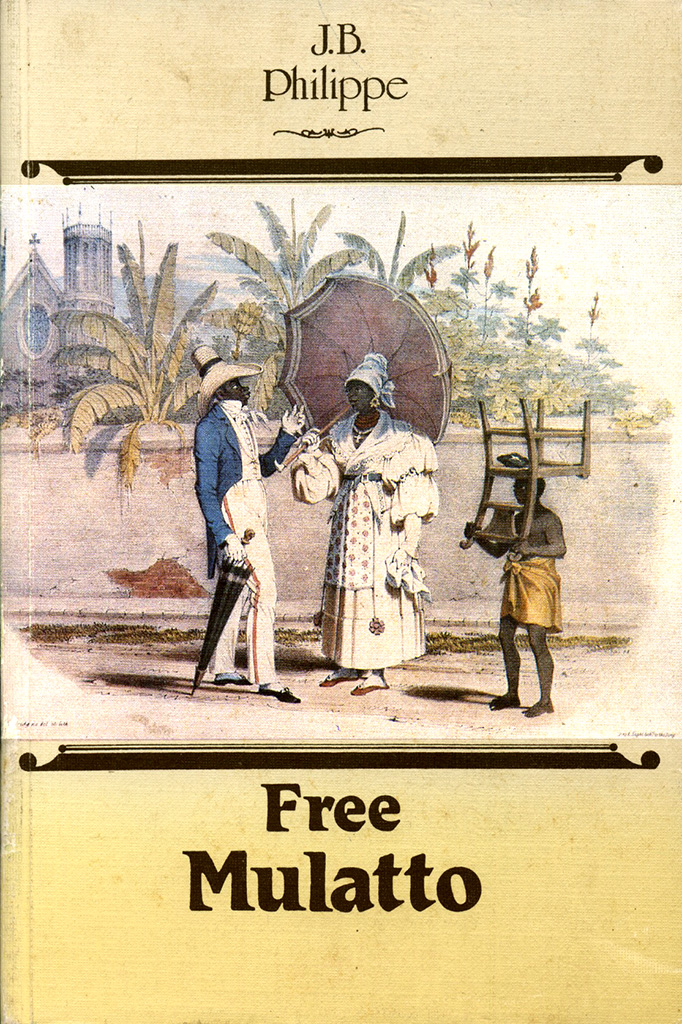
Jerry was always very interested in J.B. Philip and in 1987, published "Free Mulatto" as one of the early publications by his publishing house, Paria Publishing, which he founded in 1981.

We found an essay by his good friend Bridget Brereton in our archives, which we reproduce below. She wrote this in early February 1988 as a newspaper article for the Trinidad Express. 

Jerry's dedicated hi last book, "Philippine Book Second and Third", to Bridget, who truly can be described as his mentor and muse, and Paria Publishing's greatest friend and helper.


J.B. PHILIPPE - FREE MULATTO 

(PARIA PUBLISHING CO.,1987) 

By Bridget Brereton 

Dept. of History, UWI, St Augustine, February 1988. 

Students of the social and political history of Trinidad and Tobago, and of the Caribbean, will welcome the recent re-publication of a long-neglected classic of the early nineteenth century, Jean-Baptiste Philippe's Free Mulatto, which first appeared in 1824. Paria Publishing, in the latest addition to a most impressive list of Trinidadiana, has just brought out what will clearly be the definitive edition of this work. 

The history of this book is most interesting. It was written by Philippe, the son of the wealthiest coloured planter and slave-owner in Trinidad in the first years of the nineteenth century, a European-trained doctor who took on the leadership of the campaign by the island's free coloureds for civil rights and legal equality with the whites. Because of the political repression of the day, and because of the extreme frankness with which he 'names names', Philippe felt it necessary to have his book printed in London under a pseudonym, 'A Free Mulatto'. 

It was written as an address to the Colonial Secretary, Lord Bathurst, and it was printed rather than published—that is, very few copies were produced, it may never have been bound as a book, and ostensibly it was intended only for Lord Bathurst himself, though clearly copies found their way back to Trinidad. Hence its rarity. 

There were at 'least two attempts in the second half of the nineteenth century to re-issue the book: in 1862 subscriptions were opened for its publication, but, it seems, this plan came to nothing; then in 1882 a local firm, Allers and Blondel, put out a limited subscription edition with a new publishers' preface. In the edition under review this preface is reprinted with the suggestion that its author (it is unsigned) may be J.J.Thomas. I think that we can accept this as confirmed, for at least two contemporary newspapers refer to the preface as being his work. 

It seems that Allers and Blondel put out a very small number of books, for the 1882 edition appears to be almost as rare as the original. Indeed it represented a real act of courage; people at the time were nervous about the effects of re-publishing. As one newspaper put it, "It would have been better to give a rest to the old soreness and references to obnoxious persons, whose children at least walk and move daily in our midst, till these had quitted this mortal stage"; and Thomas himself, in his preface, acknowledged the existence of these doubts. 

The extreme rarity of Free Mulatto as a result of its chequered publishing history makes the appearance of this new and complete edition a truly important event. Its value is greatly enhanced by the inclusion, not only of the 1882 preface by Thomas, but also of a most informative introductory essay by Carl Campbell, the foremost academic authority on the history of Trinidad's free coloured community in the period 1783 to 1838. 

Campbell brilliantly draws together the few facts known about Philippe's life with the social and political history of the free coloured community whose leader he was between 1816, when he returned from Europe, and his early death in 1829. Indeed, the essay is really a kind of summary or distillation of Campbell's extensive researches into the history of the free coloureds which, up to now, have only been published in scholarly journals not normally accessible to those outside university circles. This makes the essay, short though it is, indispensable for an understanding of Philippe and his times. 

The preface by Thomas is interesting in its own right as a historical document and as a hitherto unknown sample of the writings of that extraordinary Trinidadian. Written in the heavy, literary and impressive style characteristic of Thomas, the preface dismisses the fears expressed by many about the possible effects of re-publication as unworthy of patriots. Thomas unequivocally claims Philippe as "the great Patriot of our country" and calls on all "Creoles" to venerate him as such. 

The text itself is a lengthy and elaborate presentation of the free coloured case for legal equality with whites, with numerous appendices which illustrate in detail the various arguments by reproducing documents or expounding particular points. Philippe's style is rather ornate and self-consciously literary, but it cannot conceal the genuine passion, indeed the rage, which clearly lies behind the formal well-rounded sentences and Latin tags. The work is fascinating not only for the mass of information on the free coloureds and their situation which it contains, but also for the vivid glimpse of an intensely interesting personality. 

There is no doubt that Philippe makes his case superbly and leaves his reader completely convinced of the justice of his cause. The special situation of the Trinidad free coloureds, expressly given rights and guarantees by the Spanish Crown, rights which were confirmed by the British king when the island changed hands in 1797, is clearly and amply documented. Indeed, the case was overwhelming, and the British government duly moved to cede legal equality to the free coloureds between 1826 and 1829 (the final grant of full equality was proclaimed just days before Philippe's premature death). 

But what is likely to strike the modern reader forcibly is that Philippe writes as the slave-owner that he was. As Campbell points out, there is no call for emancipation of the slaves, though there is at points in the argument a concern that they be decently treated. Indeed, one of the burning grievances the book details was that coloured slave-owners like Philippe were forced to "lend" their slaves to the local commandant for "free" work on local roads, wharf development and so on, without compensation to their owners. No concern for the slaves can be detected in this  discussion, only for the aggrieved slave-owners. 

Campbell is right to ask whether this flaw may not prove to be an obstacle to a general acceptance of Philippe as a national "hero". But perhaps we should be as generous as J.J. Thomas, himself the son of ex-slaves, and recognise the inevitable limitations imposed by class and by the times on Philippe's capacity in the 1820s to identify with the slaves. His leadership of the free coloured cause required great courage in the face of real dangers, and equality for the coloureds was probably a necessary prelude to emancipation. 

We can afford to agree with Thomas that Philippe deserves to be remembered as a true patriot; and we owe a debt of gratitude to Paria Publishing Company for allowing us to make his acquaintance. 


Bridget Brereton, Alice Besson, Giselle Laronde-West and Dominic Besson
at the launch of "Philippine" (Photo courtesy Paper Based Bookshop)


From the Booklaunch

The "Philippine" trilogy was launched on 22 November, 2024, at Paper Based Bookshop's "Tea and Readings" event at the Chancellor Hotel, St. Ann's.

Speaking on behalf of Paria Publishing were Prof. Emerita Bridget Brereton, who delivered remarks about the book; the author's son Dominic Besson, who read a passage from Book First; and the author's wife Alice Besson, who spoke about the making of the novels and why they had been dedicated to Peter Redhead and Bridget Brereton.

Prof. Brereton's speaking notes:


"This long novel, Philippine, which Gerry was working on up to his last days, is about actual historical people, the remarkable Philip family of Grenada, Carriacou, Petite Martinique and Trinidad, in the 1700s and the 1800s. Book 1, the longest of three, tells the story of the very unusual marriage between a French immigrant to Grenada, Honoré Philip, and Jeanette, an African-born formerly enslaved woman. The adventures of the couple and their many children, free coloured people, are told in Book 1. Book 2 is about Jean-Baptiste Philip, their grandson, the campaigner for civil rights for Trinidad’s free coloureds and author of the famous book generally known as A Free Mulatto, written in 1824. And Book 3 takes up the story of Michel (Michael) Maxwell Philip, a famous lawyer and public figure in 19th-century Trinidad.

So this is a fictionalised narrative of real historical figures living in the Caribbean (and elsewhere) during the 1700s to 1800s. Gerry did a huge amount of research, and he tapped into research by Grenadian Peter Redhead, to whom the first Book is dedicated. The novel reflects Gerry’s lifelong passion for the history of Trinidad and the Caribbean during the era of revolution and war, roughly the 1770s to 1820s, and his fascination with the mixed-up, multi-cultural people who lived there. In many ways it follows on from his earlier forays into fiction, especially Roume, the novel that preceded this one.

What is the art of the historical novel? You do as much research and reading about your subjects and the world they lived in as possible. But then it comes to areas of their lives, often including their thoughts and beliefs and passions, where the historical sources may be silent. You’re then free to use your imagination and create episodes, scenes and narratives…BUT they must be plausible, they can’t conflict with what is known about the people and the times. Gerry’s immensely creative and fertile mind enabled him to do this brilliantly.


To illustrate: Book 3 deals with Michel Maxwell Philip, born around 1829. Some sections narrate his growing up and education and life, here, in Britain, and then back in Trinidad as a barrister. But Gerry’s brilliant idea was to have sections set in 1929 involving a young CLR James, the labour leader Captain Arthur Cipriani, and Philip’s daughter Mrs Ethel Broadway. James wrote a biographical sketch of Philip which was published in the Beacon magazine in 1931; he was also working on a biography of his hero and mentor Cipriani (published in England in 1932). Gerry imagines the young James hearing about Philip, the famous barrister of the 1850s to 1880s (he died in 1888), from Cipriani, who in turn heard about him from his older family members. And he imagines James conducting interviews with Mrs Broadway, Philip’s older legitimate daughter. She’s a prim and proper Victorians lady and she doesn’t like James, but as time goes on she reluctantly and gradually reveals inside information about her long dead father. So through the interaction of James, Cipriani and Mrs Broadway in 1929, Philip’s story emerges—alongside narrative chapters of Philip’s life set in the 1800s. 

I remember telling Gerry more than once that not in a thousand years would I ever have thought of this narrative device, moving between the 1800s and 1929 and bringing in James, Cipriani and Mrs Broadway…this was the creative mind of the novelist. He was very pleased when I said this—my reward was his dedication of Book 3 to me, an honour I’ll always cherish."


Philippine - Book First (Children of the Sun)

This is not a historical novel. This is a docudrama in book form. Philippine traces the adventurous life of an 18th century free coloured family in Grenada, Carriacou and Trinidad-with excursions into France, England and, aboard a French corsair raider, all over the Atlantic Ocean.

This, Book First of the trilogy that is Philippine, captures the lives of the "Children of the Sun" of Jeanette, Free Negro Woman of Grenada, and her French husband Honoré Philip. In it, Gérard Besson places the various members of the Philip family sharply etched against the historical backdrop of the Revolutionary Atlantic, when the people of the Western World began to strain against the shackles of monarchy and servitude and the revolutions of France and South and North America, including Haiti and Grenada, uprooted the social order.

We explore the lives and characters of each of Jeanette and Honoré's children based on whichever historical evidence we have-e.g. for Judith, there is an abundance of record that demonstrates her success as a planter and business woman, as opposed to Nicolas-Régis, where all we have is his will and wove a story around him with fiction and leaving the rest to the reader's imagination. Two other sons, Joachim and Honoré fils, gave their lives in the Fedon revolution; both were convicted and hanged for their principles in their attempt of an armed fight for the rights of the Free Blacks and People of Colour.

Philippine demonstrates how a mixed-race, slave-owning family was able to navigate those turbulent times so successfully, especially as it regards the upward mobility of the mulatto woman: all three daughters of Jeanette's marry white men, but the sons marry black or coloured women.

For the interested reader, the historical documents were placed on Gérard Besson's blog "Caribbean History Archives".


About the Author:

Born in 1942, Gérard A. Besson is an independent researcher and scholar in the area of History of Trinidad and Tobago. His oeuvre comprises many titles, both non-fiction and historical novels as well as works about folklore. Besson is the recipient of the Hummingbird Medal Gold of the Republic of Trinidad and Tobago and of an honorary doctorate of the University of the West Indies. He is the founder and chairman of Paria Publishing Company Limited.


Other works by Gérard A. Besson:

Fiction:

Tales of the Paria Main Road (Creative Advertising 1973); A Diary of Dreams (Paria Publishing 1988); The Voice in the Govi (Paria Publishing 2011); From the Gates of Aksum (Paria Publishing 2013); Roume de St. Laurent ... A Memoir (Paria Publishing 2016); Philippine Vols 1 and 2 (Paria Publishing 2024). 


Non-Fiction: 

A Photograph Album of Trinidad at the Turn of the 19th Century (Paria Publishing 1985 and 2024); From Colonial to Republic (Republic Bank, with Selwyn Ryan 1987); Folklore and Legends of Trinidad and Tobago (Paria Publishing 1991); The Book of Trinidad (Paria Publishing, with Bridget Brereton 1991 and 2010); The Angostura Story (Paria Publishing 2000); The Angostura Historical Digest (Paria Publishing 2002); Scotiabank - The First 50 Years (Paria Publishing 2004); The History of Ansa McAL in the Caribbean (Paria Publishing 2006); The Cult of the Will (Paria Publishing 2010)


ISBN: 978-976-8244-51-2 

466 pages

Paperback

Available on Amazon


From the Booklaunch


From the book launch: Paria Publishing's Dominic Besson, Alice Besson
holding a picture of Gérard Besson, and Prof. Bridget Brereton
(Photo courtesy Paper Based Bookshop)


The "Philippine" trilogy was launched on 22 November, 2024, at Paper Based Bookshop's "Tea and Readings" event at the Chancellor Hotel, St. Ann's.

Speaking on behalf of Paria Publishing were Prof. Emerita Bridget Brereton, who delivered remarks about the book; the author's son Dominic Besson, who read a passage from Book First; and the author's wife Alice Besson, who spoke about the making of the novels and why they had been dedicated to Peter Redhead and Bridget Brereton.

Dominic Besson's excerpt from Philippine Book First - "Children of the Sun"


“Madame, they come to kill we!” shouted Yewande. She was hurling her weight and all her strength against the kitchen door while attempting to put the bar in place as a clattering crash filled the house with dust. “Madame, they coming in the roof. Shoot them! Shoot!” she screamed as the door was flung open and she was hurled aside. Yewande had never seen such an ugly man. His hair so red, his carbuncled face inflamed, his size so huge.

The man caught her by the neck and would have snapped it like a twig if she hadn’t plunged a carving fork into his face, which gave her a moment to get out of his grip. From the back room she heard an explosion and could smell the powder.

“Where is the food?”

“Look for gold. There must be gold somewhere.”

“She shot Beamer!”

Héloïse Dugué had defended herself against bandits before. She had held renegade blacks at bay and, at another time, faced down obnoxious French officers. She slept with a brace of loaded pistols within reach and a primed blunderbuss alongside her brass bed. They hadn’t taken her by surprise, she had been waiting for them for years. 

“Take the door down, Francis!”

But Yewande wasn’t through with the giant and she stabbed him again with the carving fork, this time in the back. Francis Spriggs felt that he could not to get away from this old woman who barred his way, a carving fork in one hand and a machete in the other, and lashed out with his fist. The blow sent Yewande sprawling to the floor of the kitchen, but not before striking her head on the edge of the iron stove.

“Take the damn door down, Francis!”

Turning about, the man raised a huge boot and took the door off its hinges, only to face Héloïse Dugué sitting up in bed, levelling her highly polished brass blunderbuss.

“Va te faire enculer! T’as pas de couilles!” 

These were the last words that Francis Spriggs heard.

As they ran into the night with what they had found in the bedroom, the storeroom and on the iron stove, the house ablaze behind them, they never noticed the young girl hiding in the cachot-brûlent, a look of terror frozen on her face. 

Captain Ned Low did not discover Héloïse Dugué’s cache of gold coins. These, in small leather bags, were concealed within the magnificent magenta knots of an embroidered Venezuelan hammock, a parting gift from a Canary Island windjammer captain. Gaining the steep incline above Gran Mal Bay, the men were disgusted to discover that the iron box, small, square and heavy, which Low had snatched from Héloïse Dugué’s bedroom, was filled with donkey-eye seeds, jumbie beads and pretty shells. Delight, however, replaced disgust when the dawn’s morning light revealed a sail upon the horizon. It was making directly for Gran Mal Bay. Waiting and watching until the schooner’s crew had come ashore they swam out, boarded her, murdered the watch and, hoisting her jet black sail, they made for Nassau, where in the months ahead Captain Ned Low, ever a notorious figure amongst the Brethren of the Coast, would be laid low by the hand of the notorious Charles Vane, captain of the Ranger.

On a Sunday afternoon some days after her mother Yewande’s and Héloïse Dugué’s murder, the girl Jeannette went alone to say a final adieu to her mother’s Vodun, as the spirit was called in the language of the Fon people. She had earlier retrieved, from their barrack room, her mother’s only possession: the small, black clay jar that she called a govi. Then, running to the burnt-out house, she carried away the silken magenta knots taken from the charred hammock. 

The evening’s warm air carried the sad smells of damp coal pot smoke and excrement from the compound’s latrines, familiar and pathetic, to blow about her as she stood in the shady hollow of the plantation’s cemetery. It was where Yewande was buried near to her owner. Jeannette, the magenta knots containing the little leather bags slung from her shoulder, knew that she was being watched. She feigned distress, as though grieving for her mother and her mistress and waited for their interest to wane as she knelt at the graveside in the gathering dusk before starting to dig, surreptitiously, deep into the soft earth into which she placed the knots that contained the little leather bags of Louis d’or. 

She imagined that she was placing the little bags of gold coins into her mother’s hands. She thought of them as her mother’s wages for her labour and in a more obscure way in payment for her life. The maintenance of the small clay jar, she understood, was now her responsibility. She had an idea of sorts that it held not just the guardian spirits of her mother and her grandmother, but also their fetishes, the small personal objects and little lucky charms that served, in the ancient tradition of the Fon people, to retrieve the best of their past so as to gain a favourable future, even after death."


A Photograph Album of Trinidad At the Turn of the 19th Century

This whimsical collection of photographs of the 19th and early 20th century was Paria Publishing’s first “coffee table book” and first published in 1985 in a very large format exclusively in a local print run in Trinidad.

In 2024, to commemorate the first anniversary of Gérard A. Besson’s death, Paria decided to re-publish the book and make it available worldwide via online book stores in a somewhat smaller format. The book was also augmented — according to Gérard’s wishes —  with some new old photographs that have been added to Paria’s archives in the last decades.

The publication of these photographs was made possible mainly because of two splendid albums of old photographs of Trinidad that were given to Besson by Michael Pocock and Ruby Harding Findlayson. They are mostly of the 1890's and they form the basis of this album. Various other contributors have added photographs to the Album. 


About the Editor:

Gérard A. Besson, HBM, D.Litt.h.c. was the founder of Paria Publishing in 1981, and he held the position as our Chairman until 2023. A dedicated historian, there was little he didn't know about the history of Trinidad and Tobago. Jerry created Paria's historical archive that can make thousands of historical photographs and documents available for customers who are looking for content, and specialised in museum and exhibition design. Jerry was an independent scholar and author. He died on 25 July 2023 at the age of 81.


Other works by Gérard A. Besson:

Fiction:

Tales of the Paria Main Road (Creative Advertising 1973); A Diary of Dreams (Paria Publishing 1988); The Voice in the Govi (Paria Publishing 2011); From the Gates of Aksum (Paria Publishing 2013); Roume de St. Laurent ... A Memoir (Paria Publishing 2016); Philippine Vols 1 and 2 (Paria Publishing 2024). 

Non-Fiction: 

A Photograph Album of Trinidad at the Turn of the 19th Century (Paria Publishing 1985 and 2024); From Colonial to Republic (Republic Bank, with Selwyn Ryan 1987); Folklore and Legends of Trinidad and Tobago (Paria Publishing 1991); The Book of Trinidad (Paria Publishing, with Bridget Brereton 1991 and 2010); The Angostura Story (Paria Publishing 2000); The Angostura Historical Digest (Paria Publishing 2002); Scotiabank - The First 50 Years (Paria Publishing 2004); The History of Ansa McAL in the Caribbean (Paria Publishing 2006); The Cult of the Will (Paria Publishing 2010)


978-976-8244-57-4

240 pages

Hardcover

Fully illustrated in black and white


Available on Amazon.


Family Album

Poems by Ian McDonald

Selected and edited by Robin McDonald

This book of heartfelt poems from the pen of one of the Caribbean region’s leading poets, Ian McDonald, reflects his love of life and family.

His beloved wife Mary is the muse whose inspirational influence can be sensed throughout the work’s pages. 

McDonald, historian, as well as poet, invites the reader to meet his cherished family members:  from ancestors long past to parents, wife, children and grandchildren full of life.

Ian McDonald, author of the Hummingbird Tree and 12 books of poetry, is the holder of an Honorary Doctorate of Letters from The University of the West Indies, winner of the Guyana Prize of Literature for four years and is a Fellow of the Royal Society of Literature since 1970. He was born in Trinidad in 1933 and lives in Guyana. He is married to Mary and has three sons.

Cover painting by Zoey McDonald

ISBN 978-976-8244-58-1

126 pages

Hardcover

Fully illustrated

Available on Amazon

Financially Wise, Financially Strong

Anyone can achieve financial peace of mind and build wealth, and it does not start with being an investment expert. Building wealth begins with learning about money, empowering yourself to make wise financial decisions every day, and navigating the avoidable pitfalls.

Financially Wise Financially Strong provides you with a roadmap to create enduring financial strength over a lifetime by performing six Actions. You learn why each is necessary and how they connect to produce a foundation to create wealth. The Actions focus on practical knowledge and techniques that keep it simple, enabling you to apply the principles consistently and effectively.

Whether you are beginning your career or seeking stability, Financially Wise Financially Strong will teach you how to be confident with money, develop good money habits, and achieve financial success.

Kerri Maharaj has more than two decades of professional experience in the financial services industry, during which he has held senior positions in various companies. In his early years, he made several financial mistakes; therefore, he understands how a lack of knowledge could create a barrier to a better financial future. He believes passionately in the power of financial education and that such education should be practical and accessible to all.


ISBN 978-976-9729-10-0

346 Pages

Paperback

Available on Amazon and in select bookstores in Trinidad.


Tuesday, August 13, 2024

A Different Energy

A Different Energy stands as a testament to the enduring wisdom and strength of Caribbean women. It sounds a call for a more diverse, inclusive and equitable development of one of the world’s most male-dominated domains: the oil and gas industry.
Over the last decade, as global energy has become hyper-focused on the Southern Caribbean, the role and opinions of local women have too often been overlooked. In this compelling, first-of-its-kind book, award-winning lawyer-turned-writer Celeste Mohammed remedies that omission.
In powerful, eye-opening portraits of eight Trini, Surinamese and Guyanese women who are employed in the Caribbean oil and gas industry, Mohammed uses a range of styles to keep the gender conversation refreshingly candid, often humorous, and always thought-provoking.
With a voice both earnest and confiding, intellectual and intimate, this book’s commentary and analysis extract from the women’s stories lessons for any woman seeking to defy odds, shatter stereotypes, and forge paths in a business culture which underestimates her.

Celeste Mohammed is a Trinidadian lawyer-turned-writer and the author of “Pleasantview”(Ig, Jacaranda, 2021; Ouida, 2022) which won the 2022 OCM Bocas Prize for Caribbean Literature, the 2022 CLMP Firecracker Award for Fiction, and was a finalist for the UK Society of Authors McKitterick Prize for Fiction.
Celeste holds an MFA in Creative Writing from Lesley University, Cambridge, Massachusetts.
Her short stories have won numerous awards including a 2018 PEN/Robert J. Dau Short Story Prize.
A Different Energy is Celeste’s Non-Fiction debut.

Published by Words Matter Communications
ISBN: 978-976-8291-94-3
206 pages
Fully illustrated in colour

Criminal Bench Book For Barbados, Belize and Guyana

Criminal justice is essential for peace, stability, and sustainable economic and societal development. Criminal justice systems that function fairly, efficiently, effectively, and expeditiously are integral to public trust and confidence in the administration of justice, and to institutional legitimacy. 

The constitutional values and standards of the protection of the law, due process, and a fair hearing, taken in the context of rule of law obligations that apply to the Judiciary, demand that all of these performance standards are consistently met for the benefit of all court users. There are also ethical standards that apply to the discharge of the judicial function, such as equality, competence, diligence, and promptitude, and which impose institutional and individual duties and responsibilities for which judicial officers and Judiciaries are accountable.
This criminal bench book has been completed in fourteen months, from conception to publication. Substantively, it can contribute to judicial officers meeting both the qualitative and quantitative standards that they are constitutionally and ethically compelled to uphold. Institutionally, it is an invaluable resource for the three states that it is designed for, as well as for all Caribbean jurisdictions with similar laws and practices. Indeed, this bench book improves access to justice for a wide range of persons, because it can also be easily used by attorneys and citizens as a baseline guide for legal principles and procedural best practices.
The process adopted, and as described below, has sought to make sure that each jurisdiction, through its appointed judicial officers and court librarians, has had the full responsibility for their jurisdictional content and accuracy of materials. This inclusive, collaborative, and iterative process intends to ensure that nuances that are unique to each state are covered, and as well to reap the benefits in a single publication of comparative content.

Published by The Caribbean Association of Judicial Officers (CAJO)
ISBN Hardcover: 978-976-97063-0-9
ISBN E-Book: 978-976-97063-1-6
588 pages

This publication is available electronically at the CAJO’s Reports and Publications webpage

From Bliss to Chaos to Understanding

From Bliss to Chaos to Understanding
My Cancer Journey
A Personal View Of My Life’s Struggles
By Vikki Ramdass


When Vikki Ramdass was into her first year of her doctoral thesis in 2018, she was diagnosed with Stage 1, triple-negative breast cancer. She had to stop her doctorate and undergo treatment, the journey From Bliss, to Chaos, to Understanding that this memoir describes.
Many Trinidadians know Vikki through her extensive charitable work.  True to Mahatma Gandhi’s adage “Be the change that you wish to see in the world”, she represented Trinidad and Tobago, through Lions International in several Caribbean countries and is the holder of twenty gold medals from charitable walks. She was bestowed the Mere Desh Committee Award for Community Service for Indian Arrival Day in 2012 and the National Youth Award for Volunteerism by the Ministry of Gender, Youth and Child Development in 2014.
After her breast cancer diagnosis, Vikki became an advocate for breast cancer survivors. She contributed articles on survivorship with “Elephants and Tea”, a US-based online magazine to help adolescent and young adults with cancer. Amazed at the support that she received over the years of writing, she has published From Bliss, to Chaos, to Understanding to provide comfort to cancer patients, survivors and caretakers in the future.


ISBN 978-976-8244-56-7
40 pages
Fully illustrated in colour

Carmody Road

A Memoir by Robin McDonald

Growing Up in St. Augustine, Trinidad, W.I.

This charming book is part three in a series of memoirs of the McDonald family of Trinidad, after “Beloved” and “Archie”.
Here, Thelma’s and Archie’s daughter Robin digs deep into her treasured childhood where she brings to vibrant life a loving family of many interests whose days were filled with fascinating encounters and experiences of a time gone-by enjoyed to the full with friends, neighbours and people you just met. One gets a lively glimpse of the joys and sadnesses, the tests and tribulations, trials and triumphs which in those days were so much more person-to-person lived than they are in this age of electronic relationships.  Here she reconstructs the neighbourhood of St. Augustine during the 40s and 50s – creating a pictorial map as your guide. The book is also interspersed with some of her brother Ian’s vivid and heartfelt poems.
So join Robin in her re-discovery of a microcosm in time and place that has all but disappeared.

ISBN: 978-976-8244-52-9
218 pages
Fully illustrated in black and white

Order here on Amazon

Unlocking HR/IR Potential


Contemporary Perspectives on Employment and Labour Relations in Trinidad & Tobago

Courtney Arthur Mc Nish shares his contemporary Human Resource Management and Industrial Relations perspective on a variety of issues impacting today’s workplace society: its culture, practices and processes.
Having written well over 100 articles, published in print media across Trinidad and Tobago, he has carefully collated 14 chapters in this book, wherein he expresses opinions and offers workable recommendations and solutions for the HR professional.
Building on his vast experience of advocacy, equity and best practice, particularly gained from his labour law practice, McNish selected 103 articles for publication in this book. He also provided a special chapter discussing and analysing real-life case studies that HR professionals will find relevant and useful.


Courtney Arthur Mc Nish is an experienced, professional HR Consultant and IR Consultant/Advocate, practicing in the Caribbean Human Resource environment for over 35 years. He is the holder of a Bachelor of Laws Degree (University of London) and a Masters of Law Degree (University of the West Indies, Cavehill). He achieved his Associate Degree in Strategic Human Resource Management (Babson College, Boston, USA), and also holds a National Diploma in Personnel & Industrial Relations (Cipriani College of Labour & Cooperative Studies).
Courtney is the Chief Executive Officer and Principal Consultant of Human Resource Technologies Ltd., where he manages an impressive portfolio of large private and public sector clients. Prior to this, he held numerous strategic HR positions in the corporate sector.

Published by HR Technologies Ltd.
ISBN 978-976-8291-62-2 (softcover), 978-976-8291-63-9 (e-book)
280 pages


Legendary Caribbean Legal Practitioners


Edited by Winston Anderson and Denys Barrow

In this, the third volume of the CCJ Academy for Law’s Eminent Caribbean Jurists Series, we celebrate 48 well-known Caribbean Legal Practitioners, who by their life, work, and example amply deserve the adjective “Legendary”.

Chosen and written about by their peers, the essays could not be more lively and varied, and are sure to both fascinate and entertain the reader. The common thread quickly becomes apparent: these 48 stand as a pars pro toto for the legal community of the Caribbean in a formative period.
And if Legendary Caribbean Legal Practitioners will leave the reader with the realisation that the awardees in no small measure contributed to what is good and useful in Caribbean societies today, then the Academy can say with satisfaction: “Mission accomplished.”


“Whatever semblance of society we have achieved is due in no small measure to legal practitioners who have steadfastly advanced the interests of their clients against other private litigants and against the State. The greatest of these practitioners are legends whom we are proud to celebrate.”

Hon Mr Justice Winston Anderson
Judge of the Caribbean Court of Justice


Published by The CCJ Academy For Law
ISBN (hardcover) 978-976-96378-3-2
272 pages
Black and White, Fully Illustrated

 Available from the CCJ Academy For Law


Tuesday, April 18, 2023

From Tomato Boy to Business Magnate

A fascinating account of the life of a successful businessman and his family that has been 20 years in the making! "From Tomato Boy to Business Magnate" keeps what the title promises and charts, with lavish illustrations, the life both private and public of "Bally" (Mr. Balliram Maharaj, CMG) and his wife "Lilsy".

Having provided proofreading, editing, design and layout for the book, we got intimately acquainted with the manuscript that was written by Shamshu Deen, HBM, and edited by Dr. Iezora Edwards (who patiently guided us through the myriad of changes and corrections!) 

What we liked about this particular memoir was the hands-on business and life advice that Bally liberally shares: from what to do if you are kidnapped, to how to supervise cashiers, to how to deal with wire transfers and insurance contracts. In between the reader enters the magical world of a man who somehow manages to be superbly successful at his business ventures and yet finds time to get involved in steelband, the creation of a hospital, tennis and cricket, finding his ancestral village in India, local politics, the First People in Arima, playing mas—spanning all religions and cultures of Trinidad and Tobago. In short, this Tomato Boy is truly a Trini!


Easy to read, lavishly illustrated, with so many different topics being discussed and explored, this book has something of interest for everybody. And it's fun as well since it feels so personal, so rich as a legacy of an 80-year old man who has done ever so much in his life.


Softcover copies of the book are available for purchase at @admimportexport in Arima. 

Please contact Ms. Burgess at 715-8155 or giselle.burgess@admtnt.com, to reserve your copy.

ISBN 978-976-96964-1-9

404 pages, softcover, fully illustrated in colour

Monday, January 16, 2023

In Memory of Kayla-Jordan Parris, Poet, Lupus Warrior (d. 2023)


In 2015, we had the pleasure of teaming up one of our interns, Alessia Petzold, with one of our self-publishers, Kayla-Jordan Parris. Kayla was then still in her school uniform, a student at Bishop Anstey High School, and a fierce slam poet and Lupus warrior to boot.

Together, they made a beautiful book called "Kayla's Way", featuring Kayla's poems, illustrated by her cousin Stephanie Warren-Gittens. Kayla used the sale of the book to raise funds for the Voice of Lupus Foundation of Trinidad and Tobago

Kayla continued to fight Lupus and live her life to the fullest, being an outspoken social commentator. She lost her mother, who also suffered from the condition, to COVID, and heartbreakingly, this bright young light also was extinguished from this world on January 12, 2023.

Here the lovely obituary for her from the Voice of Lupus Foundation's Facebook site:

"It is with a heavy heart that the Voice of Lupus Foundation announce the sudden passing of Lupus Warrior Kayla Jordan Parris.
We first met young Kayla when she was just 9 years old when she wrote a children's book talking about what it's like living with Lupus back in 2012.
Kayla donated $1500.00 to the Voice of Lupus Foundation from her book sales.
We always kept an eye on her as we never doubted that she was destined for great things.
Boy were we right! We saw Kayla transform from a shy young girl to a beautiful young woman with a boisterous voice and a deep love and passion for the spoken word.
We are so proud of her advocacy efforts over the years to help educate Trinidad and Tobago 🇹🇹 about Lupus. Just last year, Kayla agreed to become more involved in our advocacy efforts and wear the cap of one of our Youth Ambassadors....
She passed away suddenly during the early hours of this morning. It was unexpected.
Unfortunately, this is the brutal reality of what Lupus is and what it can do.
Lupus is an auto immune disease that can be potentially fatal, wreaking havoc on all the organs and tissues in the body. There is no cure for Lupus."

RIP Kayla-Jordan Parris, brave and beautiful poet.

The Voice of Lupus Foundation continues to fight to give Lupus a Voice in Trinidad and Tobago 🇹🇹 and bolster the much needed awareness to help better support those living with the disease.
The Voice of Lupus Foundation is a registered NGO fiercely committed to improving the quality of lives for all people living with Lupus since 2011 through investing in initiatives that promote Advocacy, Awareness, Public Education and Support of Patients.
For those who wish to volunteer or donate to the Voice of Lupus can contact The VLF's  Lupus Learning Resource Centre at (868) 327-0220 or (868) 221-9677, voiceoflupus@gmail.com

Name of Account: The Voice of Lupus Foundation
Type of Account: Business Chequing Account
Name of Bank: RBC Royal Bank of Trinidad and Tobago
Account Number: 110000001427337


Friday, December 9, 2022

Via the Roundabout

Family History by Beverly Scobie

Family histories are a genre of ethnohistory that at once educate and enthrall family and friends alike. Not all members of a clan care to know about their roots, often fearing that they’ll discover phenomena and events they would rather leave buried. Yet, for those of us courageous enough to face and embrace the truth, even truth that hurts, excavating and exploring one’s family tree is thrilling and fulfilling.

This beautiful, richly illustrated hardcover book traces the history of the Cordiner/Scobie family from Tobago and Toco. The story spans over two centuries, from 1819 to now. Beverly Scobie not only wrote the text, but sourced many of the beautiful images in the book. For over two years, the author, whom we have never met in person because she is located in Brooklyn, worked closely with Paria Publishing's director Dominic Besson here in Trinidad, who carefully curated the additional content from our company archives and designed this splendid publication. 

Via the Roundabout tells a story that has never appeared in Trinidad and Tobago before with this level of visual appeal, fascinating interest, and captivating content.

"In Via the Roundabout, I trace my family’s history from Tobago in 1819 to post-Independence Trinidad and Tobago. The fascinating story begins with Margaret the family matriarch, a 22-year-old female enslaved by Arthur Cordiner, a Scotsman. Joseph Arthur of Barbados, my greatgrandfather, enters the picture post Emancipation as the island’s economy collapsed, prompting an exodus of Tobagonians to Trinidad. The majority of migrants landed in northeast Trinidad, Toco to be exact, where the cocoa estates of Sans Souci were in desperate need of labourers. My forebears were among the deluge of Tobagonians who continued to flood the northeast corner of Trinidad well into the 20th century. My father, Alpheus Scobie, in escaping his roots, joined the Seventh-day Adventists in the 1930s, passing on a legacy of integrity and industry to his 8 children, who continue their contributions to society after careers of distinction and dedication.

I grew up a stone’s throw away from the iconic Cunapo Roundabout, which marks the end of the Toco Main Road and the beginning of the Eastern Main Road, the gateway to other parts of the Island." (Beverly Scobie)

“Readers will find Via the Roundabout informative and instructive, and will deeply appreciate the fact that the story is grounded in its historical context. Beverly Scobie is eminently qualified to trace her family tree, given her legal mind and training. She writes with clarity and lucidity, weaving a compelling narrative that is sure to prompt readers to explore their own roots and to face the raw truth about themselves.” (A Reader)

"I am very impressed with the book. It is handsomely produced and visually most attractive with gorgeous pictures. The narrative is well written and compelling. You give an excellent portrait of life in Toco before the 1960s and of growing up in SG in the 50s and 60s. Well done! But I realize you are not done…" (History Professor Emerita Bridget Brereton)

So hopefully Ms. Scobie will continue another round around the roundabout!

ISBN 978-976-8244-49-9

196 pages, full colour, 8.5 x 11", hardcover

Via the Roundabout by Beverly Scobie is available at Paper Based Bookshop  Bookshop in the Normandie Hotel and online on Amazon and Barnes & Noble

#pariapublishing #caribbeanbooks #caribbeanhistory #tobago #trinidadandtobago #toco #cocoa #seventhdayadventists


Review by Selwyn Cudjoe in the Trinidad Express, 24 December 2022:

"Today is Christmas Day. Let us give thanks and praise to the birth of a wonderfully well-researched book, Via the Round About, written by Beverly Scobie. It traces one part of Scobie’s family, beginning with Joseph Arthur, the patriarch, who was “enslaved for all of his formative years”.
Scobie is ambitious. She wishes to tell of “The Scobie Family’s Story of Resolve and Resilience from 1819 through Emancipation, the Colonial Era, and Beyond”. Although this is quite a bit to chew, Scobie keeps our interest all along this magnificent journey, entertaining and enlightening us as she tells her story.
This beautifully crafted book is enhanced by the well-preserved family portraits, her photographs of the area, and the diverse richness of the Paria archives. In it, Scobie integrates the growth of her family with the development of Toco and the surrounding villages where she grew up.
Scobie’s family history starts with Peter Cordner who, in 1866, travelled from Tobago to the cocoa estates of Sans Souci, Toco to seek employment. She says of this perilous journey to Trinidad: “He and his fellow labourers continued to risk their lives traveling by small boats on the high seas, the only means of ­getting to cocoa estates.”
Thereafter, Scobie gives us a ball-by-ball description of her family’s development, their achievements, and their failures. She speaks of the pioneering work of some of her family members (such as Isaac and her father) and even the prevalence of mental diseases that affected family members, particularly Mary, her grandmother.
The bold adventures of her forebears allow Scobie to display her rich literary imagination. She writes: “When Peter Cordner first arrived, the region was still predominantly virgin forest, sparsely populated and isolated from the rest of Trinidad. The outlines of tiny enclaves were barely visible in areas where forests had been cleared. There were no lights, so that at nightfall it became pitch black and silent, except for the occasional flame of lighted flambeau. There were no roads and labourers walked for miles, most of the time barefooted, through densely wooded forests on dirt paths created by the footfall of the First People.”
Scobie’s description of the funeral rituals in the village is one of the most attractive aspects of her story—the preparation of the corpse for burial, the wake scene that included limbo and bongo dancing, the prayers that were rendered, and the pall-bearing rituals. These stirred my memories. When my father died in 1954, all of his children and close cousins were passed over his corpse three times as it lay in our living room.
Scobie’s recollection of those innocent days of yore when adults and children looked forward to moonlit nights is also memorable: “Silly as it sounds, trapping candle-flies in a glass bottle and pretending it to be a lamp was really entertaining to children back then. But they made sure to avoid any larger than usual candle-fly, convinced that it might be a Soucouyant. This was especially so, after hearing the stories of the adults who told tales rooted in folklore and legends of the islands. Stories of Papa Bois, the old man of the forest who protected the animals from hunters; Soucouyant, the old lady of the vampire family who would suck your blood while you slept; La Diablesse, the spirit of the wronged woman whose alluring dress concealed one cloven hoof; and Duenne, the baby who died without the benefit of baptism. These and a host of other frightful creatures who lived amongst the villagers, unseen.”
She also describes the native delicacies she ate, the games children played, and all of those intangible things that made those early days so special. The visual beauty of the matapal tree, the sumptuous nature of the home-made toolum and the bene balls, make the reader want to grab them and eat them off the pages.
One would be remiss if one did not speak of the central role that the Seventh-Day Adventist religion played in the lives of her family and the discipline that it imposed upon them. She says: “My parents were not well-off, but we lacked nothing. My father’s faith was the foundation on which his life was built. It taught him to be disciplined and industrious. The strict routine practised in our household when I grew up was Daddy’s letter of the law interpretation of religious doctrine espoused by the Seventh-Day Adventist denomination.”
In 1947, Melville and Frances Herskovits, famous anthropologists from Northeastern University of Chicago wrote a book, Trinidad Village, that won much acclaim. Well versed in the study of black life, they wrote about the Africans in Toco. Harold E Davis, in a wonderful review in Boletín Bibliográfico de Antropología Americana, praised them for the use of “a matured methodology based on clearly defined theoretical concepts, for this community of New World Negroes. Especially notable is the clarity of their theoretical concepts. As a result, this study of the culture of the Negro Village of Toco... has unusual value both for the cultural anthropologist and for the historian of New World cultures”.
Scobie’s book may be lacking in the use of theoretical concepts, but she tells a story that is worthy of any anthropologist, historian or casual reader who is curious about our past.
Via the Round About is not an ordinary book. There is a beauty and innocence that is especially welcomed at a time when there is so much brutality in our island, and our people are unable to appreciate their beauty and their truth.
Therefore, congratulations are in order for Beverly Scobie for showing us this magnificent slice of our island and our people at a time at which it is so needed."

Friday, October 7, 2022

Nil Illegitimi Carborundum - Don't let the Bastards Grind You Down


A Memoir - Ronald  Harford’s  Recollections of  his  Life  as  a  Caribbean  Banker

“Nil Illegitimi Carborundum - Don’t let the bastards grind you down!”

Guided by this motto (and a couple of others), Ronald Harford embarked at the age of 17 to become a banker in Trinidad and Tobago. His career at first Barclays Bank and then Republic Bank was to span more than five decades, and lead him to become the managing director and chairman of Republic Bank. 

In this memoir he remembers some of the people he met along the way and the often hilarious moments that they experienced together. He also gives ample space to his family, friends, colleagues and business partners to share what they warned him would be “finally the truth about Ron”! 

The photo on the back cover was taken at his farewell gala in December 2019, his last “official” act as outgoing chairman. He thought that it would be a fitting picture to invite readers to read about his life as a Caribbean banker.


ISBN 978-976-8308-48-1

Hardcover, size 7 x 10”, 378 pages, fully illustrated


Table of contents:

·       Growing Up Years – Schooling, Childhood and Family

·       Apprentice Years – Stints in Barbados, England, Grenada and Dominica

·       Journeyman Years – Early career

·       Becoming CEO – The CLICO Drama

·   Master Years – Expanding Republic Bank into the Caribbean and Africa, Power to make a Difference Programme

·       Golden Years – Involvement in non-Bank activities, travels and family life

·       Index and Glossary


The book was printed by The Office Authority Limited, and was sponsored by Republic Bank Limited. It will be available in select local bookstores and internationally via online retailers like Amazon, Barnes and Noble and Bookshop. Proceeds will go to the Princess Elizabeth Home.

Mr. Harford’s career at Republic Bank, formerly Barclays Bank D.C.O., spanned 56 years from 1963–2019. During his tenure, beginning with post boy, he served in many different positions and under his supervision many of the present-day features of the financial system, such as credit cards and the Linx machine, were introduced to Trinidad and Tobago. He also spearheaded Republic Bank’s expansion into the wider Caribbean and even into Ghana, Africa, through the acquisition of other banks in various countries.

“Nil Illegitimi Carborundum” is his Memoir, told in the first person, in which he describes the highs and lows of his life in an approachable, easy-to-read language, often using the vernacular. It is a colourful book of an interesting life, and features many photographs of his personal collection.

Press Coverage:
Newsday 9 October 2022 
Trinidad Express, 10 October 2022:


Photos of the launch:


Launch of “Nil Illegitimi Carborundum” Memoirs - Ronald Harford’s Recollections of his life as a Caribbean Banker.


Remarks – Anna-Maria Garcia-Brooks

Wednesday 5th October 2022, 10.30 am, Arthur Lok Jack Global School of Business

Good morning, Ladies and Gentlemen.  

I must start by congratulating our country’s newest author on the production of a masterpiece.  I know that the production of this book was a gift to him and that writing his Memoirs might not have been at the top of his bucket list, but as he said somewhere during the journey to get us here, the downtime occasioned by the Covid-19 pandemic provided the ideal opportunity to reflect and put thoughts to paper.  So those thoughts are what we are here to launch and celebrate today. Congratulations Mr. Harford on this absolute treasure that is your Memoir. 

The theme of the book “Nil Illegitimi Carborundum – Don’t let the Bastards Grind you Down!”, is so apt, as it reflects advice that Ron Harford clearly followed throughout his life, as he said in his Author’s Note, and which he gave generously to us then young and upcoming executives at Republic Bank.  Often when he gave it, time permitting, it would be accompanied by the story of how he came upon the advice in the first place, sometimes spun with creative enhancements.  For my part, I would listen with rapt attention, as I did with all the stories, as if hearing them for the first time.  In a bizarre way, this advice brought me an unusual sense of relief and encouragement when I received it - relief in recognising that someone else understood that there was a challenge that had the potential to break me, and the encouragement that I didn’t have to let it.  It said that my reaction to situations would be my choice.  I could let the situation grind me down, or I could choose to rise above it.  Ron Harford always reminded us how important it was to rise above; to take the high road, to not be drawn into petty, time-wasting squabbles; to be the bigger person – always, to think the long game and be long brained as he would say with his mischievous grin.  Always give people their just due – be fair; acknowledge their contributions, celebrate them, be magnanimous.  He taught us these lessons and many more by his words and actions.  Working with him was like working with a driven, passionate yet caring professor from whom you learnt every day.   

I had the great honour of reading this book prior to its final publication, at the author’s request. Truth and facts are very important to him, as are integrity and honesty.  He wanted me to read and critique.  To be brutally candid where I needed to be, point out areas that, from my perspective, should be changed and of course to pick up any grammar and syntax issues – “just give honest feedback”, he said, “I value your views”. So feedback I gave.

I must confess that I originally started reading the book while seated at my desk in my home office, approaching it like an editing task, not expecting what I was to encounter.  However, knowing the gentleman as I do, I should have anticipated what was to come.  It wasn’t a task at all; it was the most entertaining and enjoyable read that I’ve had in a very long time.  I would burst into spontaneous uncontrollable peals of laughter at the accounts told by a most accomplished storyteller; be shocked and even mortified by his candour in recalling some events; and reflect thoughtfully on his analysis of situations.  

So, after reading the first part of “The Growing up Years” and realising how entertaining and how much humour resided within its pages, I abandoned my desk and set aside a couple of hours each night, sitting in my bed, propped against some comfy pillows, armed with yellow post-it slips and pen to make notes, and read to be entertained, as well as to critique; to reminisce, to learn of new adventures and to live vicariously through others.  His voice could be heard in every word, every sentence and every paragraph written.  The experience was like stepping back in time and imagining what life might have been like in the 1940’s and 50’s in Port of Spain, Guyana and other parts of the Caribbean.  It was visualising myself in some of the situations in which he found himself and wondering what I might have done.  It was a remarkable stroll down memory lane.  It seemed that adventure followed him, or maybe he just found the adventure in all that he did.  He always told us to have fun doing our work and to spend time exploring, wherever we went, learning the history of places – whether on business or pleasure.  

The experience of reading this book was akin to listening to him tell the stories – the expressions are authentically his.  This is Ron Harford.  

He is so well travelled and well read, and has visited so many parts of the world, that when he speaks about them, his contributions are from actual experience.  I remember that when I had to travel to Petit Martinique for the opening of our branch there, he told me to take the ferry, which was really a pirogue in disguise, and go across to PSV Island and drive around in the golf cart to see where the movie stars stay when they visit. He told me don’t be surprised when the plane is landing in Carriacou to see men running helter skelta out onto the tarmac to shoo away the goats, and he was correct – it happened exactly as he described it.  When my sons were children, and I told him that Gerry and I were taking them to the south of England on holiday, he told me to make sure and take them to pick strawberries, to run in the fields and to walk around Stone Henge.  And for each of these recommendations there would be a wonderfully amusing story attached.  

During my reading of this book, one night around 11.30 pm, after drying my eyes, having emerged from a fit of uncontrollable laughter from one of his humorous quips, I decided to send a What’s App message to Mr. H., telling him just how much I was enjoying the book and what a delightful task he had given me.  Having sent it and realising the lateness of the hour, I hoped that his phone was silenced, as my intention had not been to awaken him and Alison at that hour – it was just to reach out to say, “this is so much fun.  Thank you”.  I saw from the two blue ticks that he read the message sometime the next day and knew that he would have been amused by the feedback.  

To say that I enjoyed one chapter more than another would be an untruth, but while the Growing up Years, the Apprentice Years and the Journeyman years intrigued me and sparked my imagination, it was the chapters on Becoming CEO and the Master Years that I connected with the best.  Obviously because I related to those legs of the journey, along with all the other employees at the Bank.   

That story of the Barclays manager who gave him the sage advice in Latin which now forms the theme of his memoirs, and many other stories with which he regaled us during our time, some of which are contained in the book, helped in their own way to build us, to mould us into the Republic culture and I daresay, to shape the culture itself.  I remember thinking that his words will live on, when after a monthly sales meeting, sometime in 2006, Derwin, said to the team, “as the Chairman would say, let’s go and make a dollar!”  Mr. H. always said that to us!

Stories are such an integral part of the shaping of organisational culture, of transmitting and sharing history, of building bonds of friendship that endure, of sharing who you are, of allowing people to see you – really see you beyond the facade, and as you would read in his memoirs, Ron Harford has had no qualms about letting people see him.  What you see is what you get.  He strategizes and plans for the future, but he doesn’t play mindless games.  He is focused and pointed and would shoot 10 questions at you before you could answer the first.  

It’s also fascinating the impact stories of events can have on your life and your actions.  His account of how he found the old letters from Colonial Bank and took the initiative to protect them, hiding them safely at the back of the Bank’s vault and having the audacity to write on the box that they should not be removed, by order of Ronald F. deC. Harford was a tremendous inspiration to me.  I was amazed that someone so young and so relatively junior, could be so audacious and authoritative – what a leader! The letters of course now form part of the UWI’s collection and are preserved for future generations.

I learnt a few lessons from that story though – I learnt about genuine initiative; foresight to see the future and to see the value of something that might have been underestimated; I learnt about the importance of protecting and preserving, and at the right time celebrating that which has been part of our history; of who we were, who we are and who we can become.  But perhaps the most important and impactful lesson for me, was that regardless of who we are, or what our status might be, we each have a voice, and we can take action and ownership; we can make decisions and we don’t always have to get prior approval – sometimes just asking for forgiveness afterwards is enough – that’s another bit of advise that I sometimes followed.  Mr. H.  many of those lessons guided my life at the Bank and outside, and I thank you for them.  

Apart from being a flawless, ingenious and entertaining storyteller, Ronald F. deC. Harford is a true Caribbean legend, and the stories contained in the pages of these memoirs are rich and a veritable treasure trove of lessons from which young, and not so young professionals could learn. Lessons on how to dream and to go after your dream; lessons in resilience, patience and playing the long game: lessons in dealing with difficult personalities; lessons in humility, acknowledging what you don’t know and the openness to learn from everyone; lessons in being gracious and recognising someone else’s strength and celebrating their successes; putting in the effort above and beyond what is expected of you; recognising and nurturing talent.  In today’s business world, considerable time, effort and financial resources are invested in teaching supervisors, managers and even executives how to be mentors – in his time, Ron Harford did that naturally – its who he is, and while it’s not said explicitly in the book the reader gets that message from his actions. 

Like his predecessors, especially Dunbar Mc Intyre and John Jardim, Victor Mouttet, Ronald Huggins and Lloyd Samaroo, all of whom I have had the pleasure of working alongside, Ron Harford has been a huge contributor to the growth and success of the Republic Bank that we know today.  He scoffs at being called a visionary, but he is one.  Very much a family man, whose wife, children, siblings, parents and relatives came first, I sometimes felt that Republic tied for first place in his heart.  That enduring love for the organisation was compelling and infectious.  Those of us who worked closely with him felt it, we lived it and we embraced it ourselves –Nigel, David, Jackie, Karen, Tony, Derwin, Robert, Ainsworth and so many others.   

So Mr. H, your memoirs are a treasure and a must read.  Thank you for sharing your wonderful journey and adventures with the world through them and the honour of being a part of your journey.  I shall never tire of reading these memoirs.  

I thank you.


Remarks by Bridget Brereton, Professor Emerita of History, University of the West Indies

I first became aware of Ron Harford when I heard how, as a very young man working in the Port of Spain branch of Barclays Bank DCO, he’d rescued boxes containing correspondence dating back to the 1830s. This was from the Colonial Bank, Barclay’s predecessor here and included valuable historical source materials. He saved them from certain destruction and later donated them to the UWI Library (he tells the story briefly in his memoir). Naturally this convinced me he was a most unusual banker. Much later I learned—and saw for myself—what a consistent, generous and thoughtful friend of the University, including the ALJ Global School of Business, he had been over many decades.

Now Ron’s memoir is the record of his life mainly spent in banking, with what became Republic Bank, but I’m not here to talk about that. (Full disclosure: I don’t even bank there, except for a pathetically small account at the UWI branch.) Instead I want to think about what memoirs are and why they are valuable.

The word comes from the same root as memory, so a memoir is a person’s written memories of his/her life. Some memoirs deal only with a bit of the life, say a memoir of one’s youth and coming of age; Ron’s deals with his whole life from childhood to the present. In fact he goes further back to talk about his Grenadian forebears. (Grenadian people aren’t easy. There’s a very funny scene in the book where Ron has a dispute about a piece of land in Blanchisseuse with the late Karl Hudson-Phillips. It ends well only because they are both of Grenadian heritage.) Anyway, as it covers Ron’s whole life, it could equally be called an autobiography—a biography of oneself.

In this kind of life writing, the author crafts his own version of his story. It’s his truth, his choice of what he remembers and how, and of what he chooses not to remember, or at least not to write about. It’s how he orders his memories. Usually, someone who’s no longer young looks back and reflects on his life’s journey, its good and bad episodes. Nearly all memoirs or autobiographies, including Ron’s, are like that.

So a memoir or autobiography is very different from a biography, where someone’s life is researched and written by someone else. Often the subject is safely dead. With most biographies, an effort is made to achieve objectivity—as Oliver Cromwell told the painter who was doing his portrait, it must be “warts and all”. We don’t look for objectivity in a memoir, where we know that the author has chosen what memories to write about and how. This of course doesn’t mean that things have simply been made up, just that the author is free to shape his memories as he thinks best.

People have been writing memoirs for centuries, all over the world, and for many different reasons. Often they are not meant ever to be published or even to be read by anyone, or only by family. Perhaps the reason might be to reflect on your life, to make sense of it, to convey to your children what your life was like and where you came from. Or to meditate on your spiritual journey (many memoirs have been written for religious purposes).

People in public life—overwhelmingly men until quite recently—tend to write intending their memoir to be published and so to be read by a much wider group. Politicians are especially likely to write memoirs, often based on diaries they kept when they were involved in public life—I don’t know if Ron used diaries as a source or just relied on his memory. One motive for this kind of memoir is clearly to justify one’s life, defend and ‘big up’ one’s achievements, maybe put down one’s opponents. Some recent memoirs from prominent local politicians seem to fit that description.

Others who write memoirs intended for publication want to document their life and achievements so that others can learn from them, and to contribute to the history of the institutions they have been part of. This is a sort of archival purpose. Probably Ron’s book fits into this category.

I’m a historian, so I want to emphasise how valuable memoirs/autobiographies are as sources. Even unpublished memoirs, hand written, typed or word processed, can often be found in family possession, or in archives and libraries; if they’re published like Ron’s they are of course easily accessible. Memoirs are among the many kinds of written sources on which we can base the study of the past.

Needless to say, historians never read memoirs uncritically. We know all too well that they are carefully crafted representations of someone’s life. So we always seek corroboration from other sources, and if we can’t find any, we are cautious in how we incorporate material from a memoir into our research. Nevertheless, memoirs have always been recognized as important primary sources for the historian.

As I said, politicians, and more generally men who have been in public life, are especially likely to publish memoirs. Business people have been less so inclined. But in the subfield of business history and more generally economic history, memoirs and diaries by industrialists, merchants, financiers and bankers have been very important. Some go back to the 1500s, for European history.

Locally, we’ve begun to see the publication of memoirs, or biographies which are partly memoirs, by prominent businessmen…the late Anthony Sabga and Sidney Knox, for example, and Ken Gordon, happily still with us. My spies tell me that one by or about Mr Lok Jack is in the pipeline too. As a banker, Ron’s memoir fits into this trend, and provides a view of the financial side of business development in T&T and the Caribbean over the last half century.

So speaking now as a historian, as well as a friend and admirer of Ron, this memoir is very welcome. It makes a valuable contribution to understanding the economic history of the nation and region since Independence. It is also a lively read, with the unmistakable Harford voice and larger than life personality coming through very clearly. I congratulate Ron and Republic Bank on the appearance of this book and hope that many people read it.

(The speech was read by Mr. Harford's daughter, Kathryn Hosein.)


Presentation by Alice Besson (Producer of the Book) and Jacqueline Quamina, Derwin Howell, David Dulal-Whiteway, Mario Affonso, and Gregory Thomson (former RBL Colleagues of Mr. Harford)

One of the leitmotifs of the book is “flying in little rinky-dink planes in the Caribbean”. 

You know what I mean right? Those one or two-propeller affairs, held together with spit and duct tape, that buzz around the islands and Guyana?

Well, I think I need to bring some witnesses on stage, long-standing sufferers who Ronald made to fly in those contraptions. 

Would you please join me on stage: Jacqueline Quamina, Derwin Howll, David Dulal-Whiteway, Mario Affonso, and Gregory Thomson.

One day, Ronald arranged to go to Tobago to explain the rollout to a branch manager there. To Mario Affonso’s total shock, there on the tarmac stood a little one-engined four-seater propeller machine! It was a little plane that all bankers shared to transport work between Tobago and Trinidad.

Mario Affonso:

“I sat down in total fright and watched Ron Harford like a child in the plane, fearless, enjoying himself. We went Tobago, we visited the branch, had lunch with Carl Chatoor, the manager, and talked our business. Then we had to fly back. By the time I got back to Trinidad, I was so scared out of my britches, I don’t think I ever wanted to travel after that. I got a long-lasting fear of flying out of that from which I never really recovered. But that was another side of Ron Harford: what I am getting you into, I am comfortable with it, and I am enjoying your discomfort. He used to have this Dennis the Menace little smile on his face—he knows you are uncomfortable and he is enjoying it! And you are miserable and vex with him because he is enjoying the fact that you are so miserable! But that was Ron Harford—he has this little childishness inside of him, still does.”

One thing that everybody seems to agree on is that if you are travelling with Ronald and walk through an airport, you had to RUN to keep up with him! Nobody walked as fast as he did! 

David Dulal-Whiteway:

“We always joke about travelling with Ronald. Ronald is one busybody! Going through an airport with him, we were always rushing to keep up with Ronald. He would be teeming going through the airport. After 9/11, they had all these additional security checks, and he used to say, ‘That’s okay for them, but they are not supposed to treat people like us like this too!’”

How did Ronald get his colleagues to climb into these sardine tins with wings? Here’s Jacqueline Quamina’s take:

Jacqueline Quamina:

“We were going to St. Vincent to look at a bank. It’s early morning, we are going on a private plane, and we went to the old airport in Piarco, myself, Gregory Thomson, Ron Harford. When I saw the plane that we were going in—a little yellow thing—I thought, “My God, we are going in THAT? Look at the size of it! I have a daughter at home, I really should not be going on a plane like this.” I don’t think I had ever been in such a small plane. I was waiting to see if Gregory was going to say anything, but he didn’t. So we went. Peer pressure! But I had never been so close to the clouds before than in that little yellow plane with four seats.”

Flying back from a branch visit to Linden in Guyana the pilot tried to find Ogle, the airport, without radar or GPS. Ronald instructed his colleagues Kamala Singh, Karen Yip Chuck and Richard Vasconcellos to look out the windows to find the airport in the misty darkness settling. Eventually, they spotted Ogle, and landed brushing the tops of the sugarcane fields. A member of the long-suffering team from Trinidad stepped off the plane, and kissing the ground, said, ‘Thank you Lord!’ 

And then there is the famous story of Gregory Thomson being dragged twice by Ronald across the Atlantic. In one day.

Gregory Thomson:

“Ronald actually did drag me twice across the Atlantic in one day! We flew from Trinidad to London, arriving early in the morning, and went straight to meetings with Barclays. They were coming out of their Caribbean branches, and we wanted to see if we could buy their interest in the region. Immediately after the main meeting at 3 or 4 o’clock, we were catching a flight from London to go to Toronto, and arrived in Canada at about 6 o’clock in the afternoon. When you are working with Ronald, time is of the essence! The next day, we had a meeting with Royal Bank, to try and see if we could buy Royal Bank of Trinidad and Tobago, RBTT. So the first day we tried to buy Barclays, the next day Royal. “Action in their tail!” as Ronald says!”

One another occasion, coming back from Barbados with Roop, Derwin Howell and Charles Mouttet, here’s what happened. Fasten your seatbelts!

Derwin Howell:

“Coming back from a Board meeting in Barbados, our flight was delayed and Ronald got Bizzy Williams to lend us his plane to take us back to Trinidad. The plane was much smaller than we thought it would be; it could only hold four people. There was a big couch this way, and two seats that way, and there were the pilots’ seats. We got into the plane, I lounged in the back on the sofa and Charles got the co-pilot’s seat. As we went up, we realised that the one of the windows wasn’t functioning properly, we were trying to close it, and suddenly it blew out! So there we were, travelling at 3,000 feet, cold breeze BLAZING! I was getting the full blast, but Ronald was determined to go to Trinidad! Then the pilot asked, “What’s going on? The plane is decompressing!” Ronald said, “Well, the window is blown out!” So he circled around and eventually came back in. But Ronald wasn’t taking that as a no, and the pilot said that they would fix the window and in about an hour we could take off again. Well—we weren’t going anywhere with Ronald! We had to go and stay in a hotel, and eventually the regular flight left at 5 a.m. the following morning. We didn’t get much sleep that night!” 

So these are some of the stories of flying all over the Caribbean in little rinky-dink planes. You will have to read the book to find out about how Ronald had to sit under an umbrella in a leaking plane flying to Suriname on a rainy day. Or how David had to fit into the toilet of a plane coming back from the Cayman Islands. And many other weird adventures!

Thank you for contributing to the book …. And for living to tell the tale!